The Tea Taiwan Almost Forgot
Most visitors to Sun Moon Lake leave with a tin of Ruby 18.
Almost none of them have heard of the tree that made Ruby 18 possible.
There is a grove of 80+-year-old tea trees growing on a hidden hillside above Fish Pond Township, and if you did not know what you were looking at, you might walk straight past them. In fact, they have been here far longer than the farm around them.
The man who tends them goes by Assam Liang — a name he gave himself, wearing his obsession openly. His given name is Liang Huang-Yi, and he has spent the better part of 20+ years at the Taiwan Tea and Beverage Research Station's Fish Pond Branch, studying, cataloguing, and quietly championing a tea that most of the industry left behind.
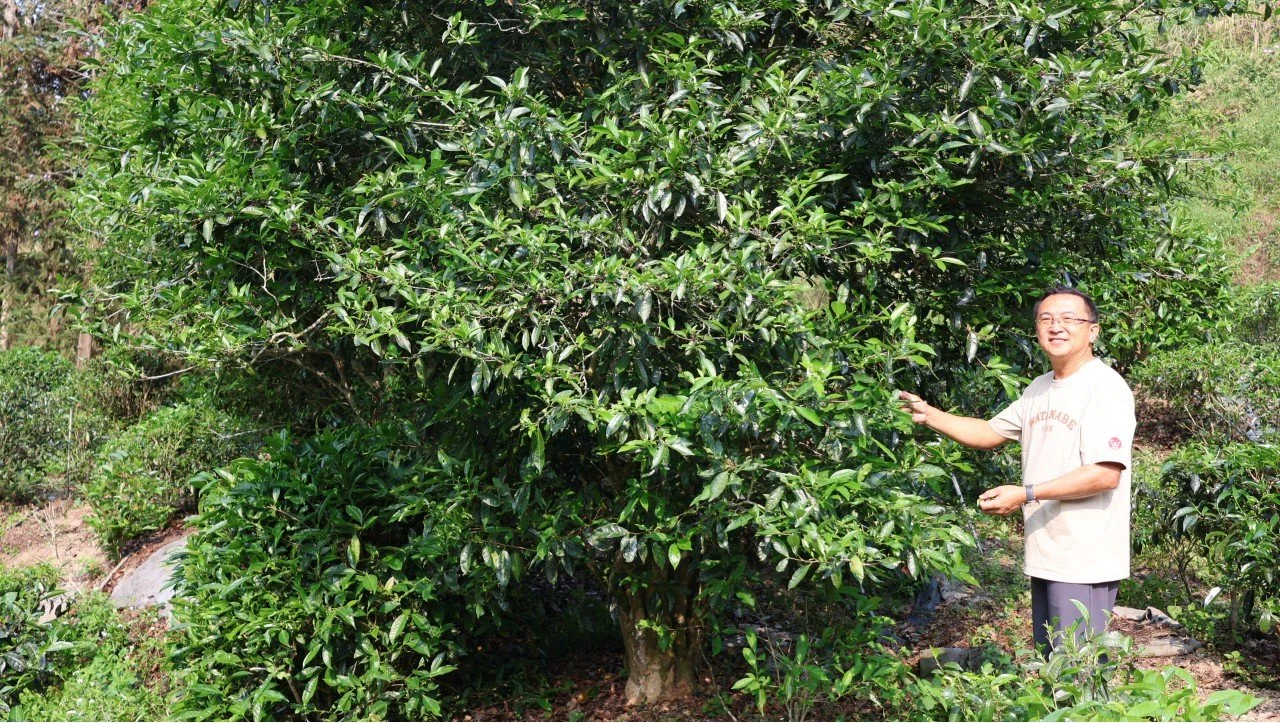
Assam Liang found a 80+ year old, over 4m high Shan Cha tree.
The original tea of Taiwan
“Taiwan Shan Cha” — Camellia formosensis — is not a cultivated variety. It is a wild, indigenous species, native to the island's mountain forests and genetically distinct from every tea plant imported from China or India. Historical records from 1717 describe the wild tea of the Shuishalian mountains — the area surrounding what is now Sun Moon Lake — as abundant, medicinally potent, and difficult to reach. The Dutch East India Company noted the presence of tea trees in this valley as early as 1644.
For most of the last century, Shan Cha was the forgotten parent. It is, in fact, one half of Ruby 18 — Taiwan's most celebrated black tea — yet the tea that made that fame possible was itself abandoned in favour of higher-yielding Assam varieties. It was too slow to propagate, too difficult to scale, too wild for industrial farming. The industry moved on. The trees stayed.
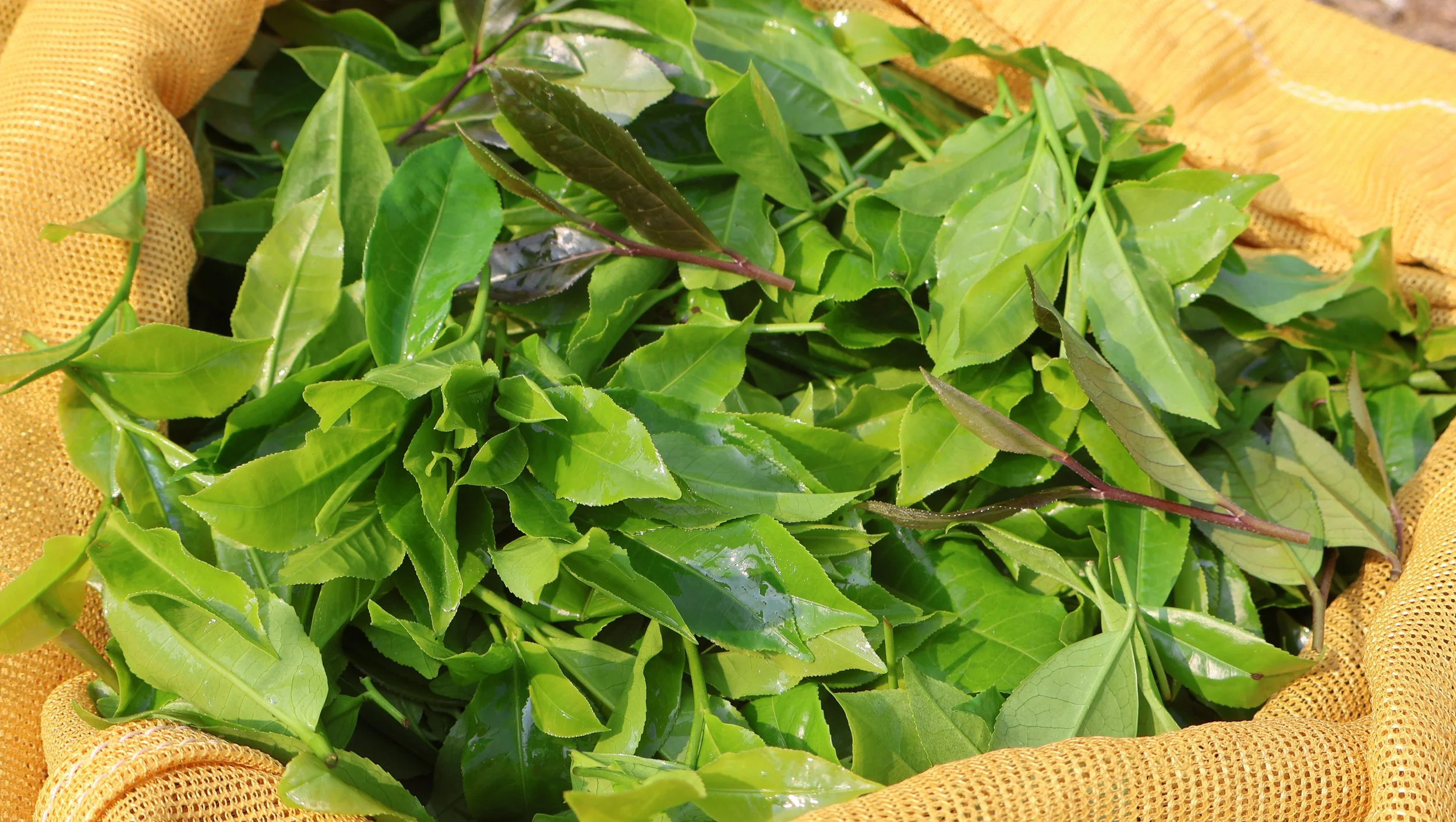
Taiwan Shan Cha is a glacial relict — isolated on this island for tens of thousands of years, it evolved into a species entirely its own, with a flavour profile found nowhere else on earth.
What Assam is building
Liang's work at the fish pond station is unhurried by design. He has catalogued the old-cultivar trees one by one — their growth patterns, their health, their particular character — treating the garden less as a production site and more as a shared ecology. The spiders in the branches and the holes a pangolin has pressed into the bank overnight are, in his words, part of what he is here to protect.
His approach to the soil is similarly unorthodox. He lays spent coffee burlap sacks across the garden floor and lets sun, rain, and time break them down into organic matter. What coffee roasters would pay to dispose of becomes, slowly, the nourishment of a tea garden. It is the logic of natural farming: not forcing, not supplementing, but giving the land what it needs and waiting.
The tea itself rewards that patience. Shan Cha carries a flavour profile unlike anything in Taiwan's established canon — earthy, deep, with notes of mushroom and forest floor that some have compared to truffle. Its caffeine content is naturally low. It is a tea that tastes like the mountain it came from.
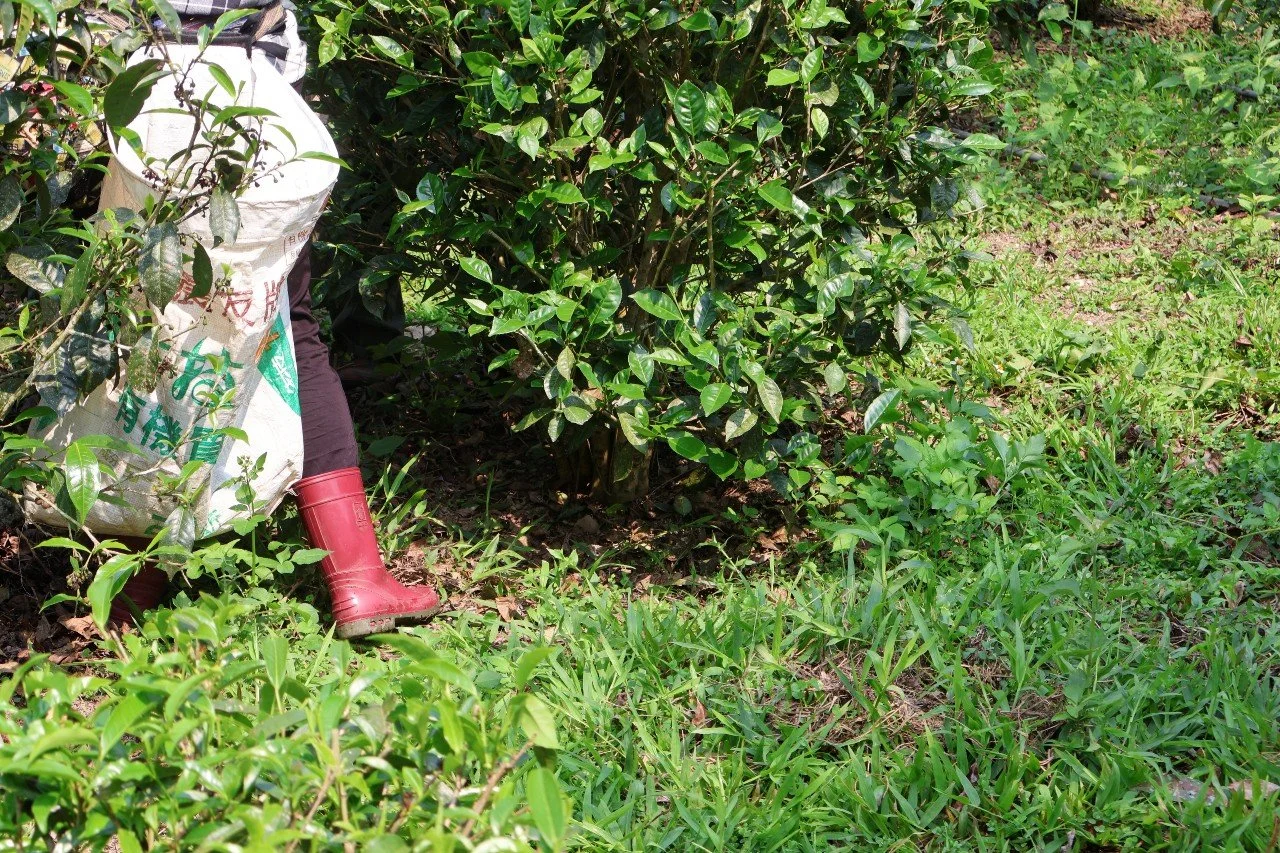
No herbicides. Weeds are left to find their own balance with everything around them — the soil stays richer for it.
Someone should look after these trees
“What motivates you to start this Shan Cha project?” I asked.
Liang answered without hesitation: "It's yuánfèn," he said — fate, or perhaps something closer to a destined connection.
He explained that within the Tea Research Station, Shan Cha had long been overlooked. Without obvious commercial value, nobody paid it much attention. Then, through a chain of small chances, he came across this particular piece of land — and found himself standing among dozens of Shan Cha trees, each one over 80+ years old. Something stirred in him, the way it does in people who love tea deeply. Someone should look after these trees, he thought. That someone turned out to be him.
From that point on, his commitment to natural farming was non-negotiable. Even where young tea seedlings have been planted by hand, a portion of them are left with minimal human intervention — tended just enough to survive, but otherwise allowed to follow their own rhythm. The goal is never to impose a system on the land, but to preserve the cycles that nature already knows how to run.
Because some trees have grown to 4+ metres tall, every leaf must be hand-picked — there is no other way to reach them. That constraint keeps the operation at a scale that feels more like stewardship than production. Yields are modest, intentionally so.
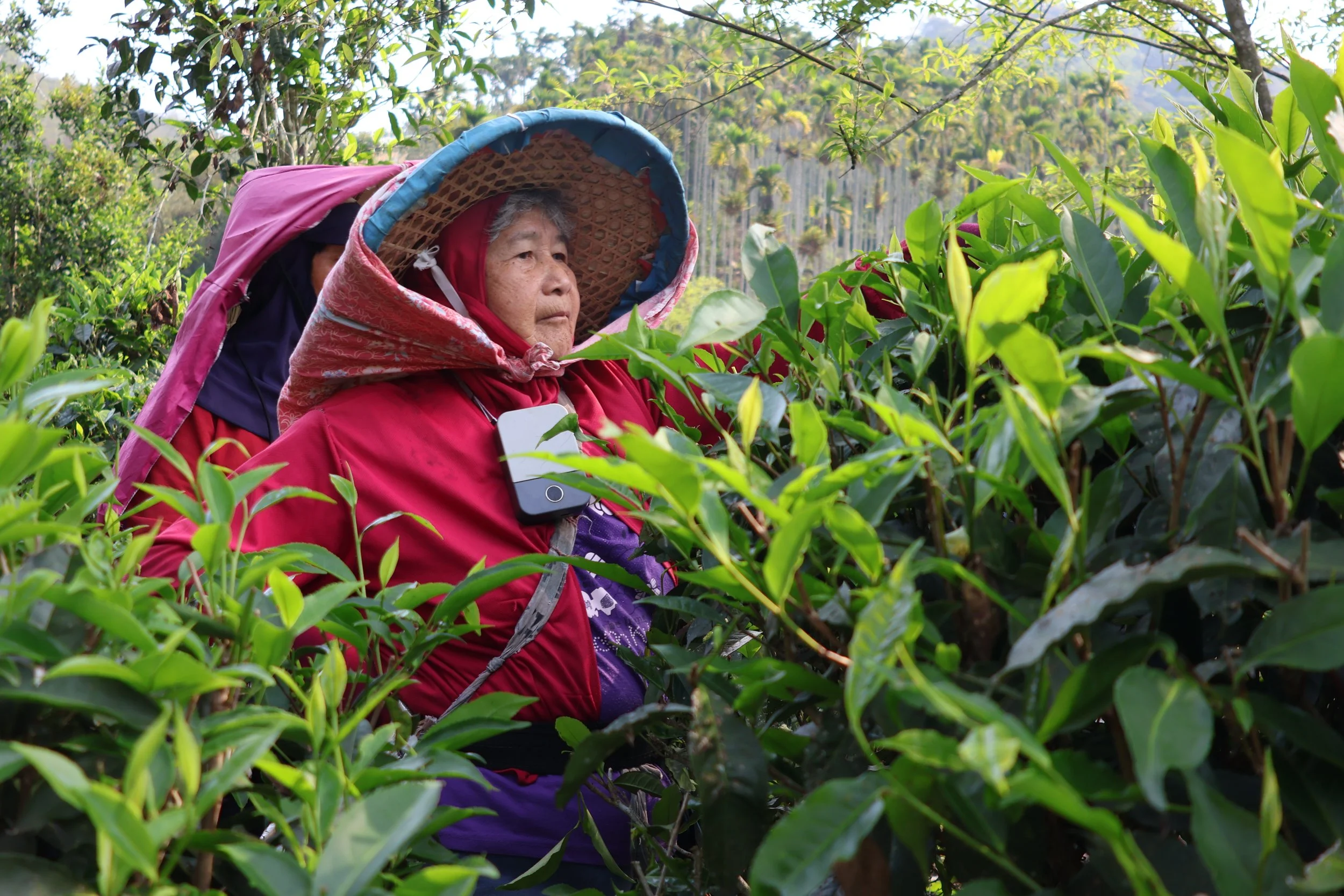
The tea pickers here work across many farms in the area.
They told me plainly: “this garden is managed exceptionally well. The trees are healthy.”
Why it matters for visitors
Each year, Liang opens 50 adoption slots for fellow tea lovers. Adopters receive a regular allocation of fresh tea throughout the year, and are welcome to come during harvest season to pick alongside the team, walk the land, and understand — not just taste — where their tea comes from. It is a small, closed loop: the trees are cared for, the people are connected to something real, and the farm sustains itself without growing beyond what it can honestly support.
Visiting a farm like Liang's — standing in that stony garden, understanding the patience behind each cup — changes what the tea means when you finally taste it. We appreciate Sun Moon Lake Shan Cha not as a novelty, but as an origin story. It is the taste of something that was almost lost, tended back to life by one person who thought it was worth the trouble.
Written & Photography by: Julien Huang©
